HN digest

Tim Peters has dieddiscuss.python.org · 1371 points · 172 comments · 6dprogrammingcultureTim Peters, a longtime core Python developer who wrote the Zen of Python and Timsort, has died, according to an in-memoriam post on the Python discussion forum.

Key points

  • The Zen of Python is the text printed by running python -c "import this", and Peters is credited as its author.
  • Timsort, the sorting algorithm Peters created for Python, is still used as the default sort in Python.
  • Peters also worked with Gary Robinson on SpamBayes, the program built on Paul Graham's "A Plan for Spam" essay.

What HN thinks

  • Many commenters describe Tim Peters as patient, kind and generous, citing his help on Usenet, Stack Overflow and python-dev, and say his writing and explanations shaped how they learned programming.
  • Commenters note his wider influence beyond Timsort and the Zen of Python, including SpamBayes spam filtering, Decimal and large-integer work, and early Python design review alongside Guido van Rossum.
  • A large share of the thread is about his 2021-era PSF suspension, with some commenters calling it unjustified and others defending the decision, and several question why the death was announced months after July.
The article couldn't be read, so this summary is based on the discussion.

Nvidia is preparing to oust Jensen Huangwsj.com · 1198 points · 1579 comments · 5dbusinesshardwareAccording to the WSJ headline, Nvidia is preparing to remove CEO Jensen Huang; the article itself could not be fetched, so the details are unverified.

Key points

  • One commenter reports NVDA shares fell almost 8% in after-hours trading after the story appeared.
  • A commenter says the NYT published an article about a second alleged affair by Huang shortly before this report.
  • A commenter suspects the ouster was already in motion after an earlier affair report and an export scandal.

What HN thinks

  • Commenters largely treat the reported affairs as secondary to the export-control and Megaspeed questions, with several arguing the key issue is whether Nvidia sales to shell companies misled investors.
  • Several commenters note Nvidia's dependence on Huang's long-term strategy, such as CUDA work begun in 2004, and question whether a successor could match that record.
  • A recurring caveat is that the reports are unverified and some commenters suspect the leaks were timed or orchestrated, so the outcome remains uncertain.

The article couldn't be read, so this summary is based on the discussion.

My AI agents found an unmapped Maya site?pietromiotti.com · 1018 points · 374 comments · 6daiscienceA non-archaeologist used AI agents on public NASA lidar data to flag a Maya civic centre in Mexico, and Mexico's INAH reports no registered site at that location.

Key points

  • Agents reviewed about 1,200 km² of lidar strips by eye, looking for pyramids, platforms and plazas while filtering out natural hills, sinkholes and roads.
  • The site includes a levelled plaza, an oval pyramid at least 8–12 m tall, a raised courtyard and a flat-bottomed hollow, under 10–17 m of forest.
  • INAH's reply said no registered archaeological site was identified at the given location, but the find is not yet officially confirmed.
  • The author's interpretation of the site as a Classic-period civic centre (AD 250–900) is speculation drawn from a chat with the agents.

What HN thinks

  • Commenters report that the site was already described in a 2025 open-access paper by Estrada-Belli and colleagues, so the 'unmapped' claim mainly reflects its absence from INAH's register, which the author later acknowledged.
  • Several commenters argue that publicizing precise lidar-derived site locations invites looting, and that leaving sites unpublicized may be safer than mass-scanning regions with AI.
  • Some note that the find itself appears genuine from the lidar imagery, while the speculative reconstruction of what the site was used for is unverified and possibly misleading.
AWS emulatorgithub.com · 946 points · 259 comments · 5dtoolsopen-sourceAWS released aws-emulator, a free local emulator of AWS APIs in Rust for testing software without an AWS account, run as a server or embedded in Rust test binaries.

Key points

  • Server mode serves HTTPS on 127.0.0.1:9297 with a self-signed certificate, and SDKs are pointed at it via environment variables.
  • Embedded mode compiles the emulator into a Rust test binary, one isolated instance per test, with no endpoint or certificate to configure.
  • Building from source needs at least 100 GB of free disk and a multi-core machine, and works only on Linux; Windows and macOS use Docker.
  • Telemetry is on by default and can be disabled by a command-line flag, an environment variable, a config.toml setting, or the embedded API.

What HN thinks

  • Commenters are split on whether aws-emulator is a durable product or an experiment, since the announcement emphasizes the agent-built process and there are few docs yet, and one commenter notes Amazon's public statements do not guarantee long-term maintenance.
  • Several commenters compare it to existing options such as Floci, Ministack, LocalStack and fakecloud, with one reporting Floci breaking between releases and another arguing that building from AWS's Smithy specs should give more complete API coverage than community emulators.
  • A commenter who ran the repo notes its size, about 2.2 GB with most of it in git history and tests, and one notes that the built-in telemetry is on by default, a concern for some users.
United Airlines bans AI agents from booking flights on behalf of travelerscbsnews.com · 633 points · 651 comments · 5daibusinessUnited Airlines is prohibiting unauthorized third-party AI agents from booking or managing its flights for travelers, updating its booking and ticketing policies to match.

Key points

  • United cites credential exposure and the risk of unintended purchases, account changes, or MileagePlus miles use as reasons for the ban.
  • The airline also says AI-assisted check-in could conflict with federal rules requiring travelers to verify in person that luggage holds no banned substances.
  • Restrictions apply directly on United's digital platforms and indirectly through travel agencies and aggregators.
  • An aviation analyst says the policy aims to keep control of the customer relationship and avoid the cost of surging AI bot flight searches.

What HN thinks

  • Commenters widely see the ban as a way to protect upsell revenue such as seat fees, ancillary add-ons and fare-package pricing, rather than a fix for the stated safety or cost concerns.
  • Several commenters argue that airlines' own chatbots and phone trees make agent access a fair counterpart, and that the rule is one-sided since companies can use AI on their side.
  • A recurring caveat is that enforcement is hard, since agents driving a normal browser are difficult to distinguish from a human, so a ban may be more symbolic than effective.
A false smoke alarm almost drowned Jane Street's only NYC datacentermichael.bacarella.com · 562 points · 262 comments · 5dsystemsbusinessA false smoke alarm from contractors' dust during prep work shut down cooling in Jane Street's NYC datacenter, and staff raced in to cut power before sprinklers could activate from rising heat.

Key points

  • The smoke alarm was wired to shut down the room's CRAC cooling units, so a non-fire alarm could let temperatures climb toward sprinkler activation.
  • Sprinkler pipes were pressurized but held dry until a heat-sensitive plug opened, so temperature rather than smoke triggered the water spray.
  • The author pulled power cords across the room as the temperature rose to 143.6 F, where it stopped climbing before the sprinklers fired.
  • Afterward the author wrote an OCaml monitor that polls every server's onboard temperature sensors each minute and alerts on a fleet-wide average rise.

What HN thinks

  • Commenters noted that the Hurricane Sandy diesel-hauling story from 2012 shows how New York facilities have long struggled with power and fuel logistics, and that Jane Street's generators on the 17th floor drew questions.
  • Several commenters questioned why the datacenter lacked an emergency power off button or a shunt trip wired to smoke detection, calling it a basic code expectation, while one with experience said untrained staff pulling plugs is often the safer manual option.
  • One commenter who has run similar server rooms explained that CRAC units are often shut down by smoke detectors on purpose, since a dry contact from VESDA or duct detectors makes manual override harder than it sounds.
93% of paint splatters are valid Perl programs (2019)mcmillen.dev · 552 points · 74 comments · 5dprogrammingcultureA SIGBOVIK 2019 satirical paper reports that OCR reads about 93% of random paint splatters as valid Perl programs, with examples shown in a gallery.

Key points

  • The author ran OCR on 100 paint-splatter images and found about 93% parse as valid Perl.
  • Seven splatters were presented as counterexamples that do not parse as valid Perl.
  • Some OCR-recognized splatters evaluate to surprising values, such as the number 0 or the string c.

What HN thinks

  • Commenters point out that the paper's point about Perl's unquoted strings is the real reason so many random inputs parse, and that the same splatters often evaluate as valid Python too.
  • One commenter notes that Java properties files are almost never invalid, since after resolving Unicode escapes any character sequence parses, which is a related example of permissive formats.
  • Several commenters joke that the joke's real value is the paper itself, with one noting Perl's error-quine footnote that works with any file path starting with a slash.
Gemini Decisions APIblog.google · 541 points · 154 comments · 5daitoolsGoogle's Gemini Decisions API scores up to 1,000 yes/no, multiple-choice, and rubric questions over one multimodal input in a single pass, returning confidence scores instead of generated text.

Key points

  • Priced at $0.10 per 1M input tokens with zero output tokens billed, and inputs billed once per request regardless of question count.
  • Reported end-to-end latency is 150-250 ms, staying nearly flat from 1 to 100 questions per request.
  • Accepts text, images, audio, video, and PDFs up to 256K tokens in one shared input, and returns a 0-to-1 confidence per answer for routing to human review.
  • Google says it is nearly 5x cheaper than Gemini 3.5 Flash-Lite with the Interactions API across its shared benchmark suite.

What HN thinks

  • Commenters largely see decision models as useful for gating, filtering, routing, and LLM-as-judge evals, with email filtering and ticket triage mentioned as concrete uses.
  • A recurring caveat is that raw LLM token probabilities are poorly calibrated, so confidence scores need careful validation, and one commenter reported a 4x lower Brier score than Jev on their own evals.
  • Several commenters argue the price is high relative to cheaper alternatives, though the multimodal input (audio, video, files) is seen as the main differentiator.
Hyper-realistic sand with WebGL2av.github.io · 423 points · 77 comments · 5dwebdesignA demo page presents a WebGL2 sand simulation billed as hyper-realistic, though the article text could not be retrieved to confirm its method.

What HN thinks

  • Commenters split on the mobile experience: several praised tilt and shake interaction and the residue effect, while others saw nothing happen or choppy, slow frame rates on older iPhones and some Android and Brave setups.
  • The strongest criticisms were that sand gets stuck in the air, stones do not rotate, and the sound effect is harsh, with one commenter noting that the red desert sand looks clumpier than the beach sand.
  • One commenter noted that the sand looks more dense when zooming on desktop because each grain is positioned in absolute screen coordinates, so grains grow but stay in place.
Protecting SSH Keys with macOS Secure Enclavegatezh.com · 365 points · 131 comments · 6dsecuritytoolsA walkthrough for storing SSH keys in the macOS Secure Enclave using built-in tools, with Touch ID required for every signing operation, and the author's verdict that the result is too ugly to keep.

Key points

  • Keys are created with sc_auth using the p-256-ne curve and -t bio, so the private key is non-exportable and each use needs Touch ID.
  • Setup needs SSH_SK_PROVIDER set to /usr/lib/ssh-keychain.dylib, since the older ssh-add -K flags do not work for Secure Enclave keys.
  • OpenSSH does not auto-discover the generated id_ecdsa_sk_rk file, so it must be listed explicitly in ~/.ssh/config.
  • The Touch ID prompt reads 'ctccardtoken needs to authenticate to continue', and keys cannot be backed up because they die with the Mac.

What HN thinks

  • Commenters widely recommend Secretive, a third-party app that keeps SSH keys in the Secure Enclave with a better Touch ID prompt, as a practical alternative to the native approach.
  • Several commenters warn that Touch ID prompt fatigue and agentic tools triggering approvals push users toward auto-approving, weakening the protection.
  • A recurring caveat is that Secure Enclave keys cannot be backed up or moved, so users need a second key such as a YubiKey and authorized_keys entries for multiple keys.
Jensen Huang said to have had relationship with executive who reports to himnytimes.com · 336 points · 397 comments · 5dbusinesscultureThe New York Times reports that Nvidia CEO Jensen Huang had a relationship with a company executive, according to sources; the article itself could not be retrieved.

What HN thinks

  • Commenters broadly argue the direct-report relationship is a governance problem regardless of morality, since power imbalances and HR policy violations raise risks for the company and board.
  • Several commenters stress that the reported Chinese-spy affair and alleged export-control issues, not the second relationship, are what create serious legal and shareholder risk for Nvidia.
  • One commenter notes Huang holds only about 3.4% of Nvidia without dual-class voting control, so the board could remove him if it judges the situation warrants it.

The article couldn't be read, so this summary is based on the discussion.

Using voltage glitching to unleash the A100 in my mining cardblog.kate.land · 327 points · 126 comments · 6dhardwaresecurityA researcher used voltage glitching on a CMP 170HX mining card to blow fuses that unlock its GA100 die, reporting an 80 GB framebuffer and about 1.2x the FP16 throughput of a retail A100.

Key points

  • Glitching is done by intercepting the PWMVID signal to the card's own VRM, timing pulses after NVVDD crosses 225mV, with success taking 1 to 48 hours of glitching.
  • The unlock works by clearing fuseless (FF) option words, which are rewritable because they are not physical fuses, while leaving the physical control fuses intact.
  • Unlocked cards enable all functional SMs, about 120 to 126 depending on the die, versus the 108 enabled on retail A100s.
  • On 8 GB cards with 80 GB of HBM intact, which the author says is roughly 90% of his sample, the framebuffer unlocks fully; one of 10 sampled cards had only 64 GB.

What HN thinks

  • Commenters broadly agree the segmentation is artificial, since the locked-off HBM and compute are often fully functional, though some note the disabled regions may hide bad memory rows that make unlocked cards unreliable.
  • A recurring caveat is that unlocked 80GB units may have faulty RAM, with one commenter noting bad regions can be flagged and ignored at a cost of a few MB.
  • One commenter with experience reports that the 8GB to 64GB unlock was reliable, while the 10GB to 80GB unlock was more problematic, and that the cards need a server cooler or added cooling to run safely.
I asked every TV manufacturer 17 questions about how they spy on youtheverge.com · 318 points · 208 comments · 5dpolicybusinessThe Verge put 17 yes-or-no privacy questions to TV and streaming companies; most answered in part, Hisense ignored it, and Sony, Vizio and Panasonic declined to answer most questions.

Key points

  • Samsung, LG and Amazon say their voice microphones listen only for a wake word or a button press, and LG says non-wake-word audio is deleted locally.
  • LG says its ACR uses audio fingerprints from the TV's internal soundboard rather than screen captures, and that ACR is off by default.
  • Google says its TV OS does not use ACR, but notes third-party TV makers may install their own ACR software.
  • A Northeastern University study found Vizio kept sending data after an opt-out, while Samsung and Roku traffic was reduced but not stopped.

What HN thinks

  • Commenters largely doubt the manufacturers' carefully worded denials, noting LG's audio-fingerprinting answer still lets TVs match viewing to on-screen content and that a settings toggle reportedly gets reverted.
  • One commenter who reverse-engineered a Roku TV reported ACR image recognition on TCL sets, and another found Samba TV spyware traffic on a 2015 Sony Bravia that stopped after disabling a bundled app via adb.
  • Several argue disconnecting from Wi-Fi is not a complete fix, and that the realistic remedies are regulation or buying unconnected commercial displays, which cost considerably more.
Lock Your GitHub Actionshugovk.dev · 317 points · 60 comments · 5dtoolssecurityGitHub Actions now supports workflow lockfiles, letting repos use readable version tags while recording the exact commit SHAs in a generated actions.lock file.

Key points

  • Running gh actions-lock with the gh-actions-lock extension rewrites tag references and writes .github/workflows/actions.lock containing commit SHAs for each action.
  • Renovate and Dependabot already support lockfiles, so periodic updates also refresh the lockfile.
  • The author suggests a separate CI job running gh actions-lock --verify on the lightweight ubuntu-slim runner to catch out-of-sync or corrupt lockfiles.
  • zizmor added lockfile support in v1.32.0, which is the first version to support it instead of hash-pinning advice.

What HN thinks

  • The maintainer of zizmor, a GitHub Actions security tool, notes that lockfiles only cover normal action calls, not reusable workflows, Docker images, or composite actions directly, so a fully locked setup is not fully immutable.
  • Several commenters say lockfiles mainly address transitive dependencies that SHA pinning missed, though some argue the gh actions-lock extension adds complexity and third-party code of its own.
  • Commenters are split on GitHub Actions itself, with some recommending self-hosted CI like Jenkins or copying action code into their repos instead of depending on marketplace actions.
Emacs in the Age of Magiccommandlinesystems.com · 289 points · 132 comments · 5daiprogrammingAn Emacs user argues that AI coding tools erase Emacs's productivity edge, using two examples of AI-built ports, excali-mode and cooked.el, to show how cheap bespoke software has become.

Key points

  • Claude Code now proposes git commit messages, so the magit workflow of staging and committing by keystroke no longer saves much effort.
  • excali-mode reimplements Excalidraw's full stack in Emacs, replacing the browser with Emacs, JavaScript with Elisp, and rough.js with C modules over Cairo.
  • cooked.el, a terminal emulation mode, includes a self-contained terminal emulator written in Rust, a large component the author calls unnecessary for the feature.
  • The author suggests a skilled Emacs developer could produce a first cut of Guile-based Elisp replacement in a long weekend, though no one has attempted it.

What HN thinks

  • Commenters broadly split between those who see AI-generated code as verbose, insecure and hard to maintain, and those who see it as a powerful tool that still needs solid engineering and architecture.
  • One commenter with experience rewriting outsourced code argued that poor-quality code is a familiar problem, and that AI-generated code may follow the same patterns of duplication and dead code.
  • Several commenters noted that Emacs users still benefit from AI, for example by running coding agents inside Emacs or using it to generate Elisp tooling, so the editor's value may shift rather than vanish.
Can a Linear Program Do Weight-Space Programming?nathan.rs · 285 points · 41 comments · 5daiprogrammingThe author shows that Astra's weight edit that cures looping in Qwen3.5-0.8B can be reproduced by solving two sparse linear programs, changing 8x fewer weights and taking about a minute per solve.

Key points

  • The LP picks an L1-minimal set of columns in layers 15 and 19 so that looping tokens are pushed away from the loop direction while productive tokens are barely affected.
  • With Astra's loop direction the LP edit changes 16,291 weights versus Astra's 130,188, and matches it on GSM8K, MATH-500 and IFEval within noise.
  • The LP's solver runs in about a minute, while an off-the-shelf HiGHS solver took over 20 minutes per solve; the author wrote a GPU PDHG solver.
  • A fixed steering vector added at inference recovers nearly the whole fix at 1x strength, though the window is narrow: 0.5x brings loops back and 2x breaks reasoning.

What HN thinks

  • Commenters largely read Astra's role as guiding the search: the LP solver replaces trial-and-error weight edits once constraints like suppress looping and preserve other behavior are stated.
  • Several pushed back on the headlines, noting Astra's early experiments edited weights directly while the math result was a targeted fix for looping that allowed forward passes to verify edits.
  • One commenter with interpretability background noted that steering-style edits are well known, and that finding a clean single direction for a specific failure mode is rarer than the headlines suggest.
Show HN: Yogurt – Free, private, open-source alternative to Granolagithub.com · 267 points · 100 comments · 5daiopen-sourceYogurt is an MIT-licensed Electron desktop app that records and transcribes calls without a bot, running transcription and summaries on-device with local models.

Key points

  • Transcription uses whisper.cpp, or Apple's on-device SpeechAnalyzer on supported macOS systems; summaries and chat use a local open-weight LLM run through llama.cpp.
  • The local LLM is auto-selected to match detected hardware, aiming to avoid heavy fan load on weaker machines.
  • Exposes a local MCP server so users can connect their notes to frontier models like Anthropic or OpenAI directly.
  • Requires macOS 14.4+ on Apple Silicon, Windows 10 2004+ x64, or Ubuntu 22.04+ x64, plus 8 GB memory; repo has 13 stars and no forks.

What HN thinks

  • Commenters point to existing open-source alternatives such as Handy, Muesli, OpenOats, Talky, and anarlog, and ask how Yogurt differs from them and from OpenWhispr.
  • One commenter raised concern that the Electron foundation may use significant memory, while another worried that building on a less mature base could lead to maintainer burnout.
  • A commenter who built a similar tool reports that speaker labels from voice enrollment are useful but not as accurate as when the call provider identifies speakers; the maintainer says Yogurt reads speaker names via accessibility permissions and suggests disclosing recordings to participants.
Apple is killing its Support Community forum next weektheverge.com · 241 points · 141 comments · 5dtoolscultureApple has made its Apple Support Community forum read-only and will permanently close it on November 20, 2026, directing users to the official Apple Support site.

Key points

  • The forum began in 1998 as the Apple Tech Exchange and served as a user-to-user tech support platform.
  • Apple has not said what will happen to decades of posts, which the article presumes will disappear with the site.
  • Apple told MacRumors the shutdown followed a careful evaluation of strategy and customer needs.

What HN thinks

  • Commenters broadly agree the Apple forum rarely produced useful answers, with many describing repetitive generic fixes like reinstalling or running reports, and threads left unresolved for years.
  • One commenter argues the forum's real value to Apple was signal about widespread problems, which LLM-era tooling could have used, so closing it loses that feedback channel.
  • Several commenters worry about where users with Apple support questions will go next and note the forum's content may survive mainly through scrapes, LLM training data, and the Internet Archive.
A great old-timey game-programming hack (2013)blog.moertel.com · 235 points · 52 comments · 6dprogramminghardwareA college student and friend sped up a 1980s PC side-scroller's tile drawing about 70% on a 6809 by using PULS/PSHU stack copies, then fixed interrupt corruption by reversing draw order.

Key points

  • Copying a 28x28 tile row with unrolled loops cost 98 cycles; the PULS/PSHU stack trick needed 56 cycles per row.
  • Stack pushes and pulls reverse byte order, so tiles were pre-processed by reversing their septets so drawing restored them.
  • The S register was commandeered, so an interrupt during drawing could corrupt memory the stack pointed at.
  • Drawing tiles right-to-left, bottom-to-top let each new tile repair corruption from interrupts before the frame was displayed.

What HN thinks

  • Commenters drew parallels to other hardware tricks, such as the 6502 BRK trick used on the Atari 2600 and the Amiga coprocessors, as examples of exploiting unintended instruction behavior.
  • Several commenters said the 6809 stack-copy trick was likely discovered independently many times, and one who worked on Color Computer games said it was known in the community by 1983.
  • Some argued such hand-tuned tricks are now mostly irrelevant due to compiler optimizations and modern CPUs, while others countered that SIMD-style hand-written code still matters.
Faster Retrieval for Better, More Efficient RAGmachinelearning.apple.com · 221 points · 38 comments · 5daiprogrammingApple researchers train small neural networks offline on a fixed key database so MIPS queries are routed or rewritten faster, improving recall at lower latency for retrieval-augmented generation.

Key points

  • SupportNet replaces centroid routing in IVF indices by scoring each cluster with a learned support function, reaching 95% routing recall about 1.9x faster than centroid routing on Natural Questions.
  • KeyNet acts as a query rewriter in front of an unchanged FAISS IVF index, reaching 99% recall up to about 8x faster at the largest size (0.23 ms vs 1.8 ms).
  • At 0.001% database scan, KeyNet-mapped queries retrieve the true key 89-97% of the time versus 86% for raw queries, per the article's evaluation.
  • The networks are trained by regression on sampled queries from the expected query distribution, so the upfront cost is paid once per fixed key database.

What HN thinks

  • Commenters debated whether retrieval biases LLMs toward heuristic rankings, with one arguing that letting the model explore without retrieval constraints yields better output quality despite the speed tradeoff.
  • A recurring point was that grep-style literal search cannot match embedding search for meaning, multilingual queries, or typos, though one commenter noted an LLM can expand concepts into multiple literal searches to approximate semantic matching.
Show HN: I recreated Papers Please but you're deciding which YC startups to fundtermsheetplease.com · 220 points · 85 comments · 5dgamingstartupsA browser game that recreates Papers, Please as a Show HN project where the player decides which YC startups get funded.

What HN thinks

  • Commenters pressed the creator to credit Lucas Pope and Papers, Please prominently, with one suggesting a direct link to the original's site.
  • Several commenters objected that the premise trivializes the original's themes of state oppression and poverty-driven moral choice, while others argued derivative works can change subject matter.
  • Some commenters questioned whether the project is meaningfully created, noting an LLM-generated remake involves far less craft than the original, though others said that matters little for a fun derivative.
Atuin Threads: All your agent sessions on every machineblog.atuin.sh · 219 points · 79 comments · 5daitoolsAtuin Threads, shipping in Atuin 18.24, syncs and indexes coding agent sessions across machines so they can be searched, resumed, or forked into a different agent such as Codex.

Key points

  • Supports Claude Code, Codex, Pi, Omp, and OpenCode, and sessions can be forked from one harness into another on a different machine.
  • Sync reuses Atuin's end-to-end encrypted engine, which treats any append-only log as syncable; capture is opt-in.
  • Sync can use the hosted server, a self-hosted server, or stay fully local.
  • An MCP server (atuin mcp, installable for Claude or Codex) lets agents search earlier sessions themselves.

What HN thinks

  • Several commenters already keep their own session search or sync setups, often using embeddings or BM25 over local session logs, suggesting demand for cross-machine agent history search.
  • The strongest caveat is privacy: some commenters are wary of sending shell history and agent sessions to a shared server, though others note Atuin encrypts data client side and can be self-hosted.
  • A commenter who tracks secret leakage from agents argues that synced transcripts could expose credentials, and another warns that agents can modify their own permission config files.
Nvidia prepares to fire CEO Jensen Huang, WSJ reportstwitter.com · 214 points · 155 comments · 5dbusinessaiA tweet says the WSJ reports Nvidia is preparing to fire CEO Jensen Huang; the linked post itself has no article text.

What HN thinks

  • Commenters are split on whether the reported affairs justify removal, with some arguing personal conduct is irrelevant to business performance and others arguing the alleged sanctions violations and spy link make his position untenable.
  • Several commenters stress that Nvidia's moat and valuation would survive a CEO change in the short term, though some warn about the long-term risks of losing its founder-driven leadership.
  • One commenter argues the board may have known about the second affair for some time and held it until it was useful, a pattern they describe as common in boards.

The article couldn't be read, so this summary is based on the discussion.

Announcing .NET 11devblogs.microsoft.com · 206 points · 255 comments · 6dprogrammingtoolsMicrosoft releases .NET 11, a Standard Term Support release with two years of support, adding C# 15 union types, a Native AOT CLI host, and expanded ASP.NET Core, Blazor, and MAUI features.

Key points

  • Union types let a value be one of a declared set of case types, with compiler exhaustiveness checks in switch expressions.
  • The SDK enables a Native AOT CLI host by default, so help and version commands run without starting the managed CLI.
  • NuGet source configuration gains a minimum package publication age setting so teams can delay newly published versions.
  • Blazor CacheView caches rendered output of a component subtree during static server rendering, skipping child lifecycle methods on hits.

What HN thinks

  • Commenters pointed to the separate Performance Improvements in .NET 11 article by Stephen Toub and a runtime release note linked from the thread.
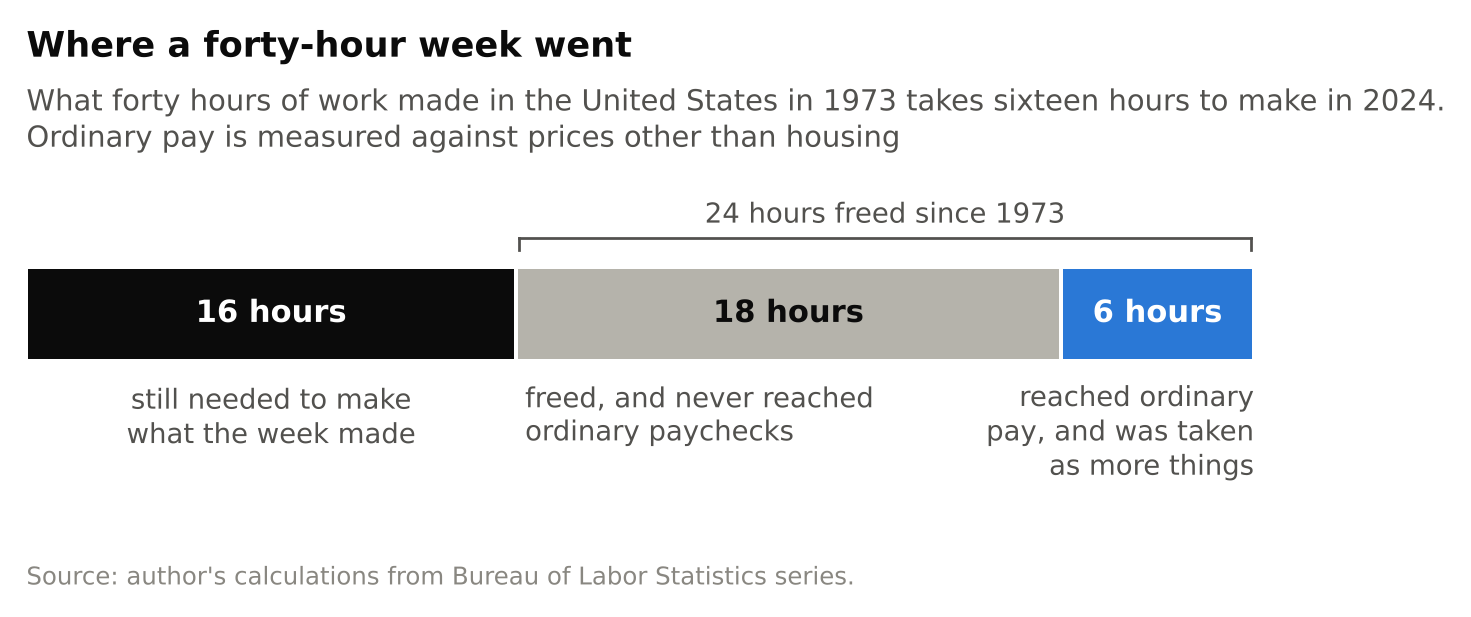
Why are we still working this hard?wilsoniumite.com · 185 points · 199 comments · 5dpolicyaiA Swedish software developer argues, using US national accounts and a model economy, that output per hour has outpaced pay, and that a common ownership share is needed to fund a second income as machines improve.

Key points

  • An hour of US business work now produces 2.5 times its 1973 output, yet an hour of ordinary pay buys only 19 percent more.
  • In the author's model, a 20 percent tax on machine earnings lowers wages by about as much as it raises, so taxing owners lands on workers.
  • Expensing investment immediately, with the government taking a fifth of new machines' returns, is presented as a way to fund public ownership without reducing machine building.
  • Acemoglu and Restrepo estimate 50 to 70 percent of US wage-structure change from automation-driven declines for routine-task workers.

What HN thinks

  • Commenters broadly agree that productivity gains have been captured mostly by investors and top earners rather than workers, though some stress that investment itself deserves a return.
  • A recurring caveat is that competition makes working less a collective action problem: a firm or worker who cuts hours risks losing out to peers who keep working full time.
  • One commenter with first-hand experience of office work argued that many knowledge workers put in far fewer than 40 effective hours, with output padded by decks and low-value tasks.
We need more goat sacrificesexperimental-history.com · 180 points · 104 comments · 5dpolicyscienceAdam Mastroianni argues that policymakers and philanthropists should be humbled by a long list of failed interventions, citing null results from school grants, laptops, cash transfers, and medical school tuition aid.

Key points

  • A 2009 Congressional spend of $3 billion on School Improvement Grants for the worst schools appears to have done nothing measurable.
  • A 10-year RCT of 531 rural Peruvian schools found zero effect of One Laptop Per Child on academic performance.
  • Kenneth Langone's $100 million for free NYU medical tuition did not change student body makeup or specialty choices, though applications rose 47%.
  • Rossi's 1987 'Iron Law of Evaluation' holds that the net expected impact of a large social program is zero.

What HN thinks

  • Several commenters argue the article's examples are too thin to support its conclusions, noting omitted factors like residency slots in the medical school case and that the piece lacks depth.
  • Commenters point out that the plain-packaging example is contested: an official report found it accelerated the decline in smoking, so a partial failure is not the full story.
  • One commenter argues that failed programs are often ones with little real power or accountability, and that metrics can be gamed, so measurement alone may not fix them.
The Utah Teapotgraphics.cs.utah.edu · 174 points · 42 comments · 5dhistorydesignThe official Utah Teapot page offers the historical teapot model versions from 1975 to 2026 for download, with a configurable generator that includes Cem Yuksel's new 2026 revision.

Key points

  • The 2026 version by Cem Yuksel has 62 patches in total, using only 30 patches for its lightweight interior.
  • Its exterior is curvature-continuous, so reflections on the surface avoid the sharp discontinuities of earlier versions.
  • Small chamfers are added where the handle and spout meet the body, shorter than the much larger chamfers on the physical reference teapot.
  • Model files are free for any use, including commercial, provided the model is credited as the Utah Teapot or Modified Utah Teapot.

What HN thinks

  • Commenters note the teapot's cultural status in graphics: it predates the Stanford Dragon by about 20 years and has been a default object in tools like 3DS Max, OpenGL/GLUT, and BeOS.
  • Several commenters highlight the University of Utah connection, where many foundational computer graphics figures worked, and where a graphics symposium has previously honored the teapot.
  • One commenter who owns both the original Friesland/Melitta teapot and the roughly 2017 reissue reports that the reissue has a built-in strainer and different interior geometry, so the models differ from the physical object.
Why I wrote the BEAM book (2025)happihacking.com · 168 points · 33 comments · 7dprogrammingopen-sourceHappi Hacking author Happi Hacking, a former Klarna engineer, explains the 2012-2025 history of The BEAM Book, an open-source guide to the Erlang VM, now printed as a paperback 1.0.

Key points

  • The project began in October 2012 as a DocBook file, was dropped for AsciiDoc, and went through two cancelled publishing deals with O'Reilly and Pragmatic Bookshelf.
  • A January 2017 import of 6,622 files into a new repo was abandoned before a fresh Asciidoctor restart in March 2017.
  • The repo was made public on 7 April 2017 and drew typo fixes, diagrams and a CC BY-4.0 license within a day.
  • Topics not in the core book include dirty schedulers, the new JIT, and the debugger, which may appear in an appendix.

What HN thinks

  • One commenter, who uses Elixir daily with LLMs on a high-traffic site handling about 5 billion HTTP requests a year on a single front node, reports that LLMs handle Elixir well and that total cost of ownership is excellent.
  • Commenters argue that the BEAM's operational strengths matter more in the AI era, with one noting it lets orchestration move safely into the application layer.
  • Commenters find it hard to persuade teams to switch from mainstream stacks like Node.js to BEAM languages, despite the runtime's strengths.
The Apple Support Community will permanently close on November 20, 2026discussions.apple.com · 139 points · 221 comments · 6dtoolscultureApple's Support Community forum stops accepting new posts today and will be permanently closed on November 20, 2026, remaining read-only until then.

Key points

  • The announcement directs users to the official Apple Support site for guidance instead of the forum.
  • The site has been read-only since the announcement, with a shutdown date set about a year out.
  • Commenters say the forum was long used for workarounds to macOS breakages, such as toggling Local Network permissions for Sonos after updates.

What HN thinks

  • Commenters are split: many say the forum was mostly unhelpful generic responses, while others say it was useful for confirming widespread bugs.
  • One commenter notes that Apple reportedly removed posts documenting confirmed security vulnerabilities, a point raised as a criticism of the forum's moderation.
  • Several commenters suggest MacRumors and MacPowerUsers forums as alternatives, and some note that LLMs are used to search the archive.
To deter bioterrorism, U.S. imposes new rules on ordering synthetic DNAscience.org · 139 points · 115 comments · 6dpolicyscienceThe U.S. has imposed new rules on ordering synthetic DNA, though the article itself could not be retrieved, so details come only from the discussion thread.

What HN thinks

  • Several commenters argue the rules are easy to get around, noting that Esvelt says the policy only screens sequences of 50 base pairs or longer, so fragments under that threshold could be stitched together from multiple suppliers.
  • Commenters doubt the rules will deter a determined actor, since the synthesis of known toxin or pathogen sequences doesn't require AI and the screening would not catch novel designs.
  • Some commenters think the rules mainly target suppliers through customer identity checks and sequence screening, and one commenter with direct knowledge notes that newer enzymatic synthesis methods can build oligos up to about 1,000 bases.

The article couldn't be read, so this summary is based on the discussion.

A general purpose Apple Silicon layer for x86-64 PCsgithub.com · 126 points · 52 comments · 5dsystemshardwareStela is a UEFI boot program that aims to run macOS on x86-64 PCs by translating arm64e code and driving NVIDIA GPUs through a Metal-to-Mesa shader path.

Key points

  • The translator covers over 3,000 AArch64 instruction encodings, mapping guest registers to host registers and caching translated code, and runs on any x86-64-v2 CPU.
  • The Metal driver supports GTX 16 and RTX 20 series GPUs and newer, compiling Apple's AIR shader IR directly to Mesa's NIR.
  • Requirements include 8 GB RAM, Secure Boot off, a USB stick of at least 8 GB, and an empty GPT partition of at least 60 GB.
  • Stela currently models a Mac mini (M2) and runs macOS 27, with setup downloading macOS over the network during installation.

What HN thinks

  • Commenters clarified that the project is a translator and emulation layer rather than a Rosetta-style tool, with one noting that it resembles a bare-metal type 1 emulator.
  • Commenters pointed out that the Golden Gate build still ships an x86_64 kernel, and one explained that Rosetta 2 needs x86_64 system libraries, which may explain the presence of x86_64 components.
  • Several commenters noted that Intel Macs still receive microcode, Mesa, and kernel updates, and one said Linux runs noticeably faster on an Intel MacBook than macOS does.
Huawei releases MACaQ, its internal quantizer for local inferencegithub.com · 123 points · 29 comments · 5daiopen-sourceHuawei's open-source MACaQ quantizes text, image, video and audio models to low-bit formats like GGUF, W4A4 and weight-only, targeting llama.cpp, vLLM, Diffusers and PyTorch.

Key points

  • It quantizes a 122B-parameter model in 64 minutes using 32.5 GB of device memory, according to the README.
  • The README claims lower perplexity than MR-GPTQ and DuQuant++, or matching their best Llama-3-8B perplexity with 11x less quantization time.
  • On Qwen3.8-27B in vLLM, the W4A4 checkpoint is reported at 2.33x prefill and 2.58x decode speed versus BF16, with perplexity rising from 2.8463 to 2.8994.

What HN thinks

  • Much of the thread is about where to find the project rather than its technical merits, with one commenter preferring the GitHub repo over the official blog because it shows the code directly.
  • One commenter raised a hosting concern, noting that Huawei is sanctioned and third-party-hosted material outside China could disappear, which is a reason some prefer GitHub links.
  • One commenter asked whether any pretrained models were released alongside the tool, and the thread does not answer that question.

Open research, stronger privacy: Making Firefox users harder to fingerprintblog.mozilla.org · 122 points · 31 comments · 5dsecuritywebMozilla says Firefox now exposes fewer distinguishing browser details, so more users share identical fingerprints, with the latest changes shipping in Firefox 145.

Key points

  • Research used simulated measurements from nearly 25 million Firefox users, collected with OHTTP so the relay sees IPs and Mozilla sees contents but not IPs.
  • Firefox hides the size and position of the taskbar or dock from screen resolution APIs, removing a desktop layout signal from fingerprints.
  • Processor count is reported as either 4 or 8 instead of the exact number, reducing how distinctive a browser looks.
  • Some protections are on by default, while others start in Private Browsing and Strict ETP mode before becoming default.

What HN thinks

  • Commenters welcome Firefox's added anti-fingerprinting work but note Brave has long been ahead on this and Cloudflare Turnstile-style checks still fingerprint users on both browsers.
  • One commenter points out that canvas data access in Firefox already sits behind a per-site permission prompt on desktop, which overlaps with a suggestion made in the thread.
  • Privacy-focused Firefox settings have drawn complaints from some users about frequent captchas on sites, and one commenter argues that avoiding such services is the trade-off to accept, while another reports no Cloudflare problems with strict mode enabled.
Retirement Savings Are Fueling the AI Bubblelpeproject.org · 120 points · 126 comments · 5dfinanceaiAn economics professor argues that US retirement savings, including public pensions and newly allowed private-fund allocations, are financing data center buildout and the AI debt that backs it.

Key points

  • Private equity firms reportedly provide 25-30% of data center financing, according to an Americans for Financial Reform report cited in the piece.
  • S&P says hyperscaler credit quality is weakening amid projected $7 trillion in AI-related spending by 2030, much of it debt-funded.
  • More than $9 billion of credit default swaps tied to Big Tech bonds traded weekly in September, with protection getting more expensive.
  • The author says a Trump administration change now lets the $15 trillion in private-sector retirement accounts be invested in private funds.

What HN thinks

  • Commenters split on whether pension exposure is the real issue, noting that 401(k) holders choose their own investments while pension beneficiaries have no say over risk.
  • Several argued that index fund holders are broadly exposed to large AI-linked stocks, but that holding a market-neutral index is not itself a bet on the bubble.
  • Skeptics called the article's evidence thin, pointing to a single-day 4% drop as weak support and noting the article offers no quantification of private-fund allocations.
Pharo in the Browser with WebAssemblymassimo-nocentini.github.io · 116 points · 33 comments · 5dprogrammingwebA demo page that runs the Pharo Smalltalk environment inside a web browser, compiled to WebAssembly.

What HN thinks

  • Commenters are split on whether running Pharo in the browser defeats its purpose, with one suggesting the desktop environment is more appropriate for real use.
  • Several reported usability problems, including broken mouse coordinates when zooming in Firefox on Linux and a broken back button on Android.
  • One commenter noted that streaming and running a full environment in the browser still involves heavy download and resource friction compared with a native install.

The article couldn't be read, so this summary is based on the discussion.

Show HN: Black Ops II statically recompiled to native ARM64 macOSgithub.com · 115 points · 50 comments · 6dprogramminggamingbo2-mac is a GPL-3.0 tool that converts a user's own Steam copy of Black Ops II into a native ARM64 macOS app via ahead-of-time static recompilation, with Direct3D 11 drawn by Metal and no Wine or Rosetta.

Key points

  • The three executables (campaign, Zombies, multiplayer) are lifted with Remill to LLVM IR, optimized by custom passes, and linked with a hand-written Win32 runtime.
  • On an Apple M1 the campaign runs at 51–60 fps and Zombies at 57–60 fps on most maps, per the README's measurements.
  • Copy protection code runs in a small Unicorn-based x86 interpreter rather than being bypassed, and untranslated code falls back to interpretation.
  • Conversion on the player's Mac takes about 1 hour 45 minutes on an M1 and about 10 GB peak disk, and multiplayer is limited to bots with no LAN or online play.

What HN thinks

  • Commenters largely treat the project as a technical milestone, with one noting that its Pipeline section explains the approach: Remill lifts x86 to LLVM IR, LLVM emits ARM64, and a hand-written Win32 and Direct3D 11-to-Metal layer handles the rest.
  • The main criticism is that the README does not clearly explain why the project matters, since commenters question whether the game was already playable on Apple Silicon via CrossOver and Rosetta and what the native build actually gains.
  • A concrete caveat from the author is that the recompiled build is much larger, roughly 500 to 800 MB per mode versus about 13 MB for the original executable, though it still reportedly runs at 60fps.
$30M Raised to Redo the CPUtendrils.co · 113 points · 116 comments · 6dhardwarestartupsTendrils, a startup, raised $30M led by Benchmark to build a CPU with thousands of parallel cores and a new open-source language, Vine, instead of sequential designs.

Key points

  • The company says current CPUs are bottlenecked by cache coherency protocols and reorder buffers inherited from designs dating to the 1970s.
  • The chip would move beyond shared mutable memory and linear instruction sequences, targeting parallel-first architectures.
  • Investors include Benchmark, Visionaries Club, the UK Sovereign AI Fund, FR8, Antimatter, Cloudberry VC, Conviction, Embassy Ventures, and SV Angels.

What HN thinks

  • Commenters broadly see the pitch as a repeat of past massively parallel or exotic architectures like Transputer, Itanium, Mill, and GreenArrays, which mostly failed to win users.
  • The main criticism is that compilers and software ecosystems, not chip designs, decide adoption, and commenters doubt a new language like Vine can overcome that.
  • One commenter argued the Vine docs' short-circuit example is really about default non-short-circuit evaluation, which suits abundant parallel compute, though others questioned whether it is a novel idea at all.
Greg Kurtzer's Ginux is now a userspace kernelgithub.com · 110 points · 70 comments · 6dsystemsopen-sourceGinux, Greg Kurtzer's former standalone Rust kernel project, now runs as an ordinary Linux process that intercepts syscalls and enforces a per-instance contract on Rocky Linux 10 workloads.

Key points

  • Each syscall is emulated, mediated through a narrow Ginux-owned host operation, or denied, based on the instance's versioned contract.
  • The pinned Rocky Linux 10 systemd baseline reaches multi-user.target, authenticates a console login, and runs dnf updates.
  • Default selective mode permits direct host execution only for calls Ginux's catalog marks direct-safe; paranoid mode mediates every syscall.
  • The project states it is research software, not production-ready, and does not promise complete Linux ABI compatibility.

What HN thinks

  • Several commenters compare Ginux to gVisor rather than User-mode Linux, noting it offers a restricted kernel interface, with one saying gVisor gives good density and startup at the cost of app compatibility.
  • Commenters question whether a userspace kernel truly improves isolation, since it still relies on the host Linux kernel, and one points out that a new kernel is not automatically safer than Linux.
  • Skepticism centers on the project's short, casual history and rapid pivot, with one commenter arguing that little demonstrated commitment makes it unsuitable to build serious workloads on.
AWS Emulator and the engineer's job when agents write the codeallthingsdistributed.com · 108 points · 13 comments · 5daiopen-sourceAWS released AWS Emulator, a free offline local copy of AWS services for coding agents to test against, built entirely by agents from public API models and checked against real AWS.

Key points

  • The emulator is built from more than 400 API models covering over 200 AWS services and runs free and offline on the user's machine.
  • Agents write fidelity tests from Smithy API models, correct them until they pass against real AWS, then build the emulator to pass the same tests.
  • A first SQS emulator prototype was produced from a single prompt to Kiro in about 15 minutes.
  • Every change must pass a merge gate including several adversarial security agents and a general code reviewer, and the code is released under CC0.

What HN thinks

  • Commenters note that local emulators like Miniflare already exist for Cloudflare, so the novelty is the agent-built and real-service-verified approach rather than local emulation itself.
  • One commenter who has tried a similar method describes shadowing live production traffic in a sandbox and swapping in the new version once responses match, while noting payments and email can't be fully sandboxed.
  • A commenter questions the project's tracking, pointing out that about 6,500 issues in the 'things-that-do-not-work' folder are unsorted, so it is unclear whether the 12,700 'now work' entries are fixed bugs or intended features.
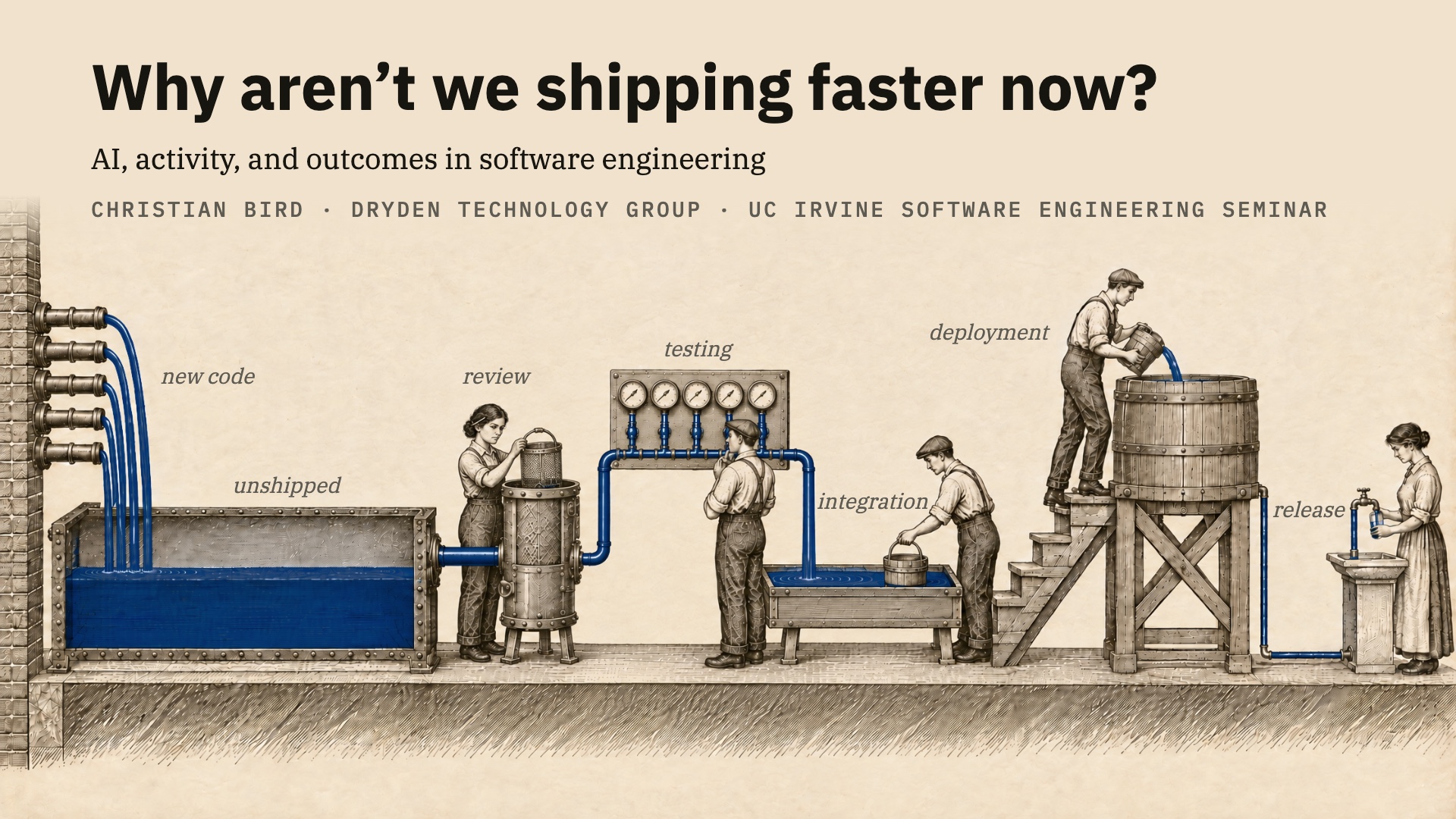
AI, activity, and outcomes in software engineeringcabird.com · 98 points · 95 comments · 5daiprogrammingA talk page for a UC Irvine seminar by Christian Bird, which argues AI boosts coding activity without a matching gain in shipped outcomes and links several supporting papers.

Key points

  • The talk cites a submitted paper, The Activity-Outcome Gap, based on 30 interviews with developers.
  • It also cites NBER Working Paper 35275 on productivity effects across generations of AI coding tools, distinguishing writing code from shipping code.
  • The page itself contains only the talk description, slides, and paper references, so the specific findings are not stated here.

What HN thinks

  • Several commenters report shipping faster, with examples like full migrations collapsing from weeks to a day and support-driven features going live within hours, though some note the speed gains mostly apply to greenfield work and prototypes.
  • A recurring caveat is that coding is only one stage: commenters point to review, QA, CI/CD, approvals, infrastructure requests, and unclear business requirements as the real bottlenecks that AI has not sped up.
  • Quality concerns recur, with one commenter reporting more broken features that get removed soon after release and another noting that faster output has raised the bug rate roughly in step with behavior changes.
Show HN: Godbolt-in-a-floating-window for Neovim (C, C++, Rust)github.com · 91 points · 17 comments · 5dtoolsprogrammingA Lua plugin for Neovim that shows generated assembly for the function under the cursor or a visual selection in a floating window, for C, C++, and Rust.

Key points

  • Uses the locally installed cc/c++ or rustc/cargo, so no internet connection is needed.
  • Supports x64 and aarch64 targets.
  • Keys in the window adjust the -O optimization level, rerun compilation, or close it.
  • Reads compile_commands.json when one is found in the project.

What HN thinks

  • Commenters pointed to existing tools for the same job, such as cargo-show-asm for Rust output and nvim-dap-disasm for disassembly during debugging, with one noting cargo-show-asm has had work on edge cases and Windows handling.
  • Several commenters praised the README for presenting core information at a glance, with one saying it seemed non-AI-written.
  • One commenter said they still write code by hand on paper while thinking through algorithms, and a separate thread debated whether AI tools make hand-written editor workflows like this less relevant.
In Defense of Giving a Shitpossibilityspace.org · 81 points · 60 comments · 6daigamingA judge for the Independent Games Festival argues the IGF needs an AI policy and that House House should not win an award after declaring LLM use in Big Walk's code.

Key points

  • The IGF had no written AI policy, leaving each judge to decide, and one third of judges were said to abstain from considering games that used AI.
  • The IGF required declarations for any AI use, unlike Steam, which only requires disclosure of AI assets consumed by players.
  • Big Walk's developers said LLMs were used for less than 0.1% of the code, to diagnose and fix errors late in production.
  • The author argues rules work mainly as a community signal and a basis for enforcement, not as a guarantee against hidden use.

What HN thinks

  • Commenters split on whether AI use should matter at all, with many arguing judges should weigh output quality rather than process, while others say awards should reflect human craft and need clearer, declared criteria.
  • Several commenters noted that declaring AI code is hard in practice, since third-party libraries and frameworks may themselves contain AI-generated code, making any rule easy to circumvent.
  • One commenter argued that the author's claim that House House could simply have hired a specialist to fix the bug is unrealistic late in a release cycle, with an unfamiliar codebase.
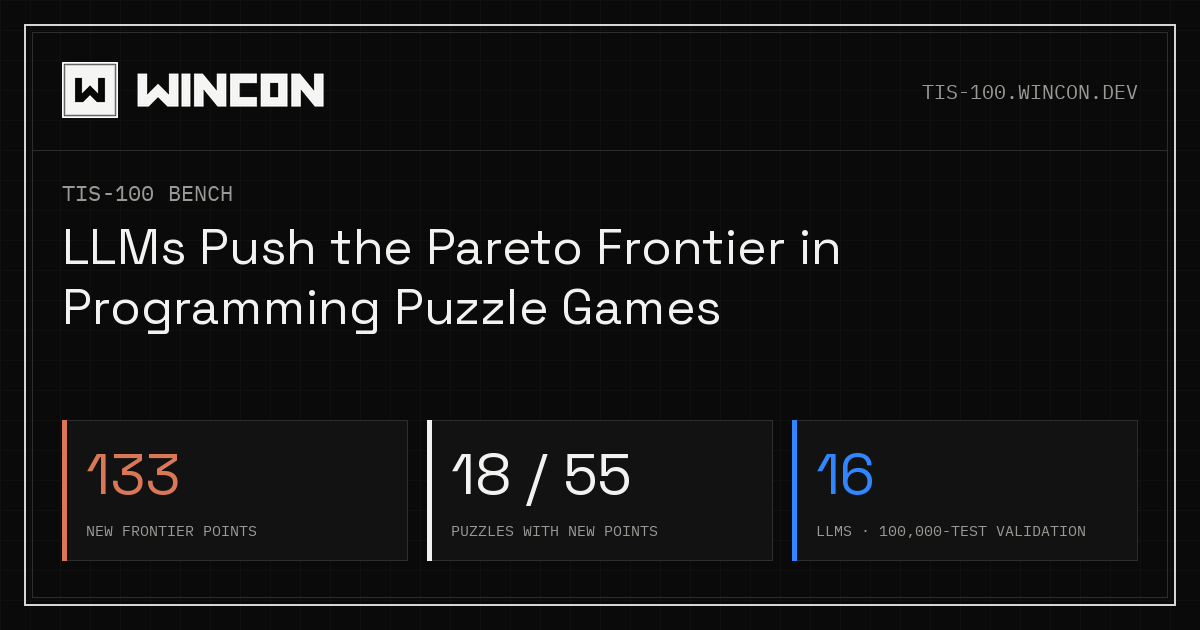
LLMs Play Zachtronics' TIS-100tis-100.wincon.dev · 80 points · 17 comments · 6daiprogrammingA benchmark gave 16 LLMs the TIS-100 programming puzzle game and found new efficiency tradeoffs on 18 of 55 puzzles, with Opus 5.5 and GPT-6 Astra leading.

Key points

  • Of 133 new frontier points, 18 beat community cycle records outright, and the rest are new cycle/node/instruction tradeoffs.
  • Models were scored pass@1 with one episode per puzzle, and a point counted only after fresh-game replay and 100,000 passing tests.
  • On one tournament puzzle, Opus 5.5 cut the community record from 2,694 to 1,918 cycles, and a community member later reached 1,744.
  • Cost did not track quality: GPT-6.1 Sol reached 75.6 record proximity at about $0.75 per puzzle versus Opus 5.5's 77.2 at $5.08.

What HN thinks

  • Commenters doubt that human leaderboards can survive for Zachtronics-style puzzle games, pointing to Advent of Code dropping its global leaderboard as a precedent.
  • Several commenters recall TIS-100 as a formative game and suggest ports to the web or a terminal UI, with open-source interpreters already available.
  • One commenter says they avoid LLM help and solution lookups so they can revisit the hard puzzles unaided, reflecting how the thread values the game's unassisted challenge.
Show HN: Aircad – Professional drafting and 3D modeling in the browseraircad.com · 76 points · 36 comments · 6dtoolsdesignAircad is a browser-based 2D drafting and NURBS 3D CAD system with multiplayer editing, version history, and a built-in AI agent that drafts changes for approval.

Key points

  • Opens and writes DWG, DXF, STEP, and Rhino 3DM files, and handles files with 250,000+ entities without splitting models.
  • The AI agent proposes edits as drafts highlighted in the drawing, requiring Apply or Discard before any change is made.
  • Scripts are JavaScript on the same API as built-in commands, run in a sandbox with no network access, and can be shared with teams.
  • Version history includes compare-any-two-versions tinting of added, changed, and removed geometry, plus forking from any point in history.

What HN thinks

  • The author, who has 15+ years in CAD kernels, explains the stack: OCCT for core operations, custom tessellation and hidden-line rendering, all compiled to WebAssembly and running client-side with WebGL2.
  • One commenter doubts a CAD business can rely on a $19/month browser tool and a website dependency, while the author argues that DWG, DXF, and STEP export provides an exit path.
  • A commenter raised a bus-factor concern about a small team building the product, which the author did not directly address.
Why Amstrad chose the 3" drivescpcwiki.eu · 75 points · 30 comments · 10dhardwarehistoryThe CPCWiki forum thread asks why Amstrad picked 3-inch floppy drives for its CPC machines, but the page itself contains only the thread header and no answer.

What HN thinks

  • Commenters who owned these machines generally praised the 3-inch disks as more reliable than 3.5-inch disks and tapes, with one noting the Amsoft jewel cases were a nice touch.
  • Commenters repeated the popular theory that Amstrad salvaged drives from a bankruptcy or abandoned project, but one commenter argues the timing makes that unlikely, leaving cost-cutting as the most plausible explanation.
  • One owner said a 3-inch drive was expensive and later swapped in a cheaper 3.5-inch drive with double the capacity, showing the format's drawbacks.
GitHub Incident with Webhooks, Actions, etc.githubstatus.com · 73 points · 52 comments · 5dsystemstoolsGitHub reported an ongoing incident on November 11, 2026 causing degraded availability across Actions, Pages, Webhooks, and Copilot.

Key points

  • Status page first posted an investigation for Pages at 20:48 UTC, then widened the incident to Actions and Webhooks the same minute.
  • Webhooks was marked as degraded performance rather than degraded availability, while Actions, Pages, and Copilot were marked degraded availability.
  • The article text is only the status page itself, so no root cause, scope numbers, or resolution time are given.

What HN thinks

  • Several commenters say they have moved off GitHub, most often to self-hosted Forgejo, Gitea, or GitLab, citing repeated outages.
  • Commenters note that incidents can linger after the status page says resolved, with queued Actions jobs and webhook backlogs persisting for hours.
  • One commenter with CI experience argues teams should always keep a path to production that does not depend on their CI provider, and another reports a fast migration to a third-party Actions runner.
Play GTA5 on Browserplaygta5.com · 61 points · 39 comments · 5dgamingwebPlayGTA5.com appears to run Grand Theft Auto V in a web browser, though the page itself offered too little readable text to confirm details.

Key points

  • The page loads roughly 800MB of assets, according to one commenter, which makes slow or stalled starts likely.
  • A linked write-up at ai.satyajit.si describes how the browser version works, though its contents were not provided here.

What HN thinks

  • Commenters split on the implications: one expects high-budget games to move toward always-online services with intrusive checks and streamed encrypted content, calling it an inefficient loss for consumers.
  • Some question the legality, asking whether copyright law still applies, while another notes that streaming in the browser differs from downloading cracked software locally.
  • Early testers report mixed results: it froze in Firefox but worked in Chrome, reportedly needs about 800MB of assets, and one user said it locked up after roughly two minutes.

The article couldn't be read, so this summary is based on the discussion.

The hardest notes to find on the guitargitori.com · 60 points · 65 comments · 5dgamingprogrammingGitori's Find the Notes game data, from 275,169 answers by over 10,000 players, shows the upper middle of the neck is hardest to identify notes on.

Key points

  • The G string at frets 6 to 9 is the hardest zone, with the B and D strings at frets 7 to 9 close behind.
  • The G string at fret 8 (E♭) is answered incorrectly about one-third of the time, the single worst spot.
  • Open strings and the 12th fret are missed about 6% of the time, against roughly 20% around frets 8 and 9.
  • About 16% of accidental answers are wrong versus 12% for natural notes, and correct accidentals take about 2.5 seconds versus 2.2.

What HN thinks

  • Several commenters argue that guitar note-finding relies on shapes, muscle memory and intervals rather than note names, so a game score may not transfer to playing a real instrument.
  • Commenters note that the game's inverted or tilted fretboard view may explain some difficulty, and one says the front-view setting maps better to how they picture the fretboard.
  • One lap steel player notes that the middle to upper neck is where they play most, since it interacts well with open strings in common tunings, which challenges the idea that these positions are hard in practice.
Show HN: Klad, a paint app your coding agent can drive (source-available)github.com · 60 points · 26 comments · 5daitoolsKlad is a source-available Rust paint and animation app where a coding agent paints through a CLI using real brushes, and every stroke stays editable afterward.

Key points

  • The agent paints via CLI with brushes, layers and timeline; there is no image model, so each stroke keeps its path, pressure, brush and colour as data.
  • A drawing is a folder of plain files, and the file format and CLI reference are MIT-licensed while the app is source-available.
  • Free for individuals and companies under 500,000 euros annual revenue; larger companies need a bought licence per user.
  • Works fully on macOS with pen pressure; Linux editor uses the mouse only and Windows has no known hand-drawn testing yet.

What HN thinks

  • Commenters asked for benchmarks; the author has none yet but reports roughly 10 to 15 minutes of agent time for the posted poster and scene examples, comparable to a medium coding feature.
  • One commenter suggested pairing Klad with image generation to separate layers, and the author noted the model would first have to redraw the whole image in Klad.
  • Commenters expressed interest in testing an agent cleaning up a real artist's pen-tablet drawing, which the author expects to work well since edits remain traceable to intent.
Attention to Mamba: A Recipe for Cross-Architecture Distillationmachinelearning.apple.com · 59 points · 5 comments · 5daiscienceApple researchers distill a Pythia-1B Transformer into a pure Mamba model without any attention blocks, via a two-stage process that first linearizes attention, reaching perplexity 14.01 versus the teacher's 13.86.

Key points

  • The first stage distills the Transformer into a linearized attention version using an adaptation of the kernel trick, then the second stage distills that into an adapted Mamba.
  • The distilled model keeps most teacher performance, but shows gaps on downstream tasks that depend more on in-context recall.
  • Ablations run at 1B scale with 10B distillation tokens, plus scaling analysis over model sizes and total tokens and a sensitivity test on token allocation between stages.

What HN thinks

  • One commenter says the hybrid SSM approach will likely bear fruit, but finds follow-up work on Mamba-3 and state prediction more interesting.
A Compendium of Abandoned Greenhousesmessynessychic.com · 59 points · 7 comments · 8ddesigncultureA photo compendium of abandoned greenhouses worldwide, from Dutch and Italian estates to the Boyce Thompson Institute in Yonkers, New York, mostly sourced from urbex photographers.

Key points

  • The Boyce Thompson Institute operated from 1924 until 1978, when air pollution and property taxes prompted a move to Cornell's Ithaca campus.
  • Since 2005 the Yonkers site has been discussed for conversion to a commercial building and wellness center, but its buildings remain in limbo.
  • A Villa Maria greenhouse near Lake Como, photographed in 1985 in derelict condition, had since been restored, per the author's comparison photos.

What HN thinks

  • One commenter noted that a supposedly unlocated 'Cosmic Greenhouse' photo could be located with a simple Google search.
Peer-to-peer WebRTC connections with built-in signaling and discoverygithub.com · 58 points · 17 comments · 8dwebopen-sourcelike-webrtc is an npm library that lets browser, Node.js and React Native peers open WebRTC connections using public-key addresses, with signaling, peer discovery and default STUN/TURN built in.

Key points

  • Peers listen on a public key that serves as their address, and others connect by that key instead of an IP address.
  • Discovery works by announcing and looking up shared topic names through a single default signaling server at party.leet.ar.
  • Signaling messages are end-to-end noise-encrypted, so the WebSocket signaling server only relays SDP and ICE data.
  • Default ICE uses three public STUN servers and one TURN server, and the library includes a P2P Discord clone demo.

What HN thinks

  • Commenters point out that a browser-only setup still depends on external infrastructure, since STUN and a signaling server are required and browsers offer no built-in peer discovery.
  • A recurring concern is that the default public signaling server could disappear, breaking apps that depend on it, so self-hosting the signaling server is the practical path.
  • Commenters compare it to existing libraries like PeerJS and Trystero and ask what it adds beyond them, with no clear answer in the thread yet.
The Computer Graphics Book of Knowledgecs.cmu.edu · 57 points · 18 comments · 5dhistorytoolsA chronological history page tracing computer graphics from 1940s analog experiments through 1990s film milestones, compiled largely from pioneers' recollections and personal notes.

Key points

  • Parry Moon and Domina Spencer at MIT computed radiosity-style lighting in the 1940s, then built the image by hand-cutting and ironing Munsell paper samples.
  • Ivan Sutherland's 1962 Sketchpad thesis ran on the TX-2, which had 320 kilobytes of memory and a 9-inch monochrome CRT.
  • Larry Cuba's Death Star shot for Star Wars took about 12 weeks and roughly two minutes of computation per frame, with a crash-prone system nearly ruining delivery.
  • Edwin Catmull's Z-buffer and texture mapping work at Utah in 1973-74 is credited among the foundations of modern rendering.

What HN thinks

  • Commenters note the page omits key milestones, such as Kajiya's 1986 rendering equation and path tracing, Goral's radiosity work, and Lance Williams's shadow mapping.
  • One commenter who studied SIGGRAPH papers as a teenager argues the page is thin on technical history and that primary sources like Veach's thesis are more valuable.
  • Commenters point out the page is a long text-only scroll with no images, which is a notable mismatch for a graphics history.
Plane lifted into back garden as bunker takes shapebbc.co.uk · 55 points · 43 comments · 8dcultureA plane was lifted into a back garden as part of a bunker under construction, according to the story's headline; the article could not be fetched.

What HN thinks

  • Commenters widely doubt the fuselage will survive long-term in soil, noting aluminum corrosion and water ingress, with several arguing that proper waterproofing, cathodic protection and a membrane would be needed.
  • Some question whether a partial fuselage has the structural strength to bear the concrete loads and burial weight, while others note the pour is being staged to limit stress.
  • Many commenters focus on the retrospective planning permission, suggesting the builder may face council problems or may have informal approval for an underground structure in a low-density area.
AI is becoming an information gateway. Audiences still don’t want it making newsniemanlab.org · 53 points · 39 comments · 6daicultureA Reuters Institute survey across nine countries finds AI use for getting information is rising fast, while most people still reject AI-made news.

Key points

  • Weekly AI use reached 51% across six countries with past data, with 49% in the U.S., which the authors say is faster than smartphone or internet spread in the U.S.
  • Use of AI for getting information rose to 38% from 24% in 2025 and 11% in 2024, with direct AI news use at 9%.
  • Only 12% are comfortable with news made entirely by AI, rising to 19% with human oversight, a figure nearly unchanged since 2024.
  • Among those who used AI for information, 75% trusted answers to factual questions, but trust is not the main reason people use it; convenience is, at 64%.

What HN thinks

  • Commenters broadly distinguish using AI to consume or search public information, which many accept, from AI producing news, which many reject.
  • One commenter argues the survey lumps together very different uses, such as fact-finding, copy-editing, and fully generated articles, so the headline result may overstate rejection.
  • Skeptics say AI's real-world effects, including layoffs and flooding public spaces with low-quality content, drive the negative reaction more than hype alone.
Flying on Green: Why Farmers Are Turning to Drones for Cover Crop Seedingagweb.com · 53 points · 26 comments · 7dhardwarescienceFarmers are increasingly using drones to seed cover crops, according to an AgWeb machinery article whose full text could not be retrieved.

What HN thinks

  • Commenters note that drilling is usually needed to get seed into soil, so drone broadcasting suits cover crops with tiny seeds that need little planting depth, and the article argues it avoids soil compaction.
  • Skeptics question drones for heavier loads, saying they are weight-limited and uneven spreading can burn crops, and that center pivot irrigation has already replaced much crop dusting.
  • One commenter with ditch-riding experience in Montana reports drones are being used to spray ditch banks more effectively than a four-wheeler or hand spraying.
IBM Quantum Nighthawk Demonstrates New Levels of Speed and Qualitynewsroom.ibm.com · 51 points · 24 comments · 5dhardwarescienceIBM says its Nighthawk r3 quantum processor will run 10,000 operations across 520 qubits, and plans to link two of them into a 1,040-qubit system in 2027.

Key points

  • Nighthawk r2, already shipping, delivers up to 100,000 samples per second with over 7,500 operations on 120 qubits.
  • Partners E.ON, Algorithmiq and Q-CTRL report up to 19x speedups after running 34 billion circuits on Nighthawk r2.
  • Nighthawk r3 adds 10 chip-to-chip l-couplers; an earlier four-coupler test reached 99.3 percent state transfer fidelity against a 99.9 percent target.
  • IBM also reports connecting two cryogenic modules, reaching operating temperature in under five days and cooling below 15 millikelvin.

What HN thinks

  • Commenters note the press release is less clear than the Ars Technica write-up, which describes the non-programmable qubits as used for leakage removal rather than computation.
  • Several commenters argue quantum processors should be judged as specialized coprocessors on problems they suit, not as faster general-purpose computers, and that this is still research.
  • Skeptics question whether any current machine yields results beyond classical capability, while one commenter points to IBM's advantage tracker and claims post-December 2025 hardware crossed that line.
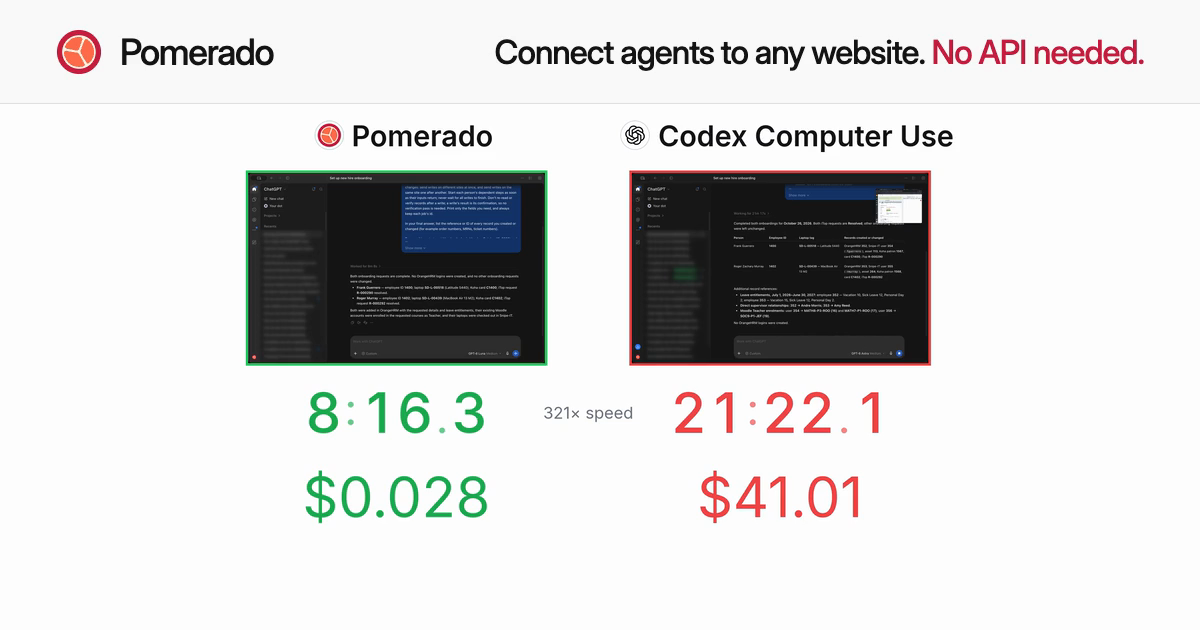
Launch HN: Pomerado (YC F26) – Turn any website into an MCP for agents51 points · 40 comments · 5daitoolsPomerado is a self-serve platform that generates a hosted MCP server for any website by recording one browser run, then turns it into a deterministic API that repairs itself when the site changes.

Key points

  • The vendor says an integration is built in under an hour and typical runtime calls return in 5-30 seconds, versus slower reasoning-based browser agents.
  • A separate Guardian model reviews the coding agent's calls against guardrails, and synthetic-input tests check the API is not overfit to one example.
  • Login and 2FA run through a deterministic sign-in process so the model never reads credentials; users can store TOTP seeds or use a Pomerado phone number.
  • Maintenance jobs repair broken steps such as renamed buttons, and the vendor reports a 7x speedup and 2x faster, 10-1000x cheaper than browser agents on its own benchmark.

What HN thinks

  • Commenters compared Pomerado with Printing Press and WebMCP, noting Pomerado works on sites without owner opt-in and uses Playwright for writes where HTTP calls trigger anti-bot defenses.
  • Several commenters raised concerns about site load and legal risk, and asked how sites could opt out; the founders said they focus on avoiding bans and do not cache or deduplicate calls, so every tool call hits the live site.
  • A recurring question was how failures are handled: one commenter warned agents may retry identical calls after a 200 response, and the team said repair triggers on failures, input-rejection streaks, and site errors, while writes are confirmed with a 'can't tell' state for uncertain outcomes.
Next-Level Benchmarking Overfitting – Thomas Neumanndatabasearchitects.blogspot.com · 51 points · 9 comments · 6daiprogrammingThomas Neumann argues that GenDB-V's reported 22x to 61x speedups over Umbra and DuckDB come from workload-specific precomputation and hard-coded TPC-H data generator knowledge, not genuine engine performance.

Key points

  • He calculates that Umbra's SF10 TPC-H run (about 540ms) is bounded near 280ms by memory bandwidth, so a 22x gain over Umbra is physically infeasible for traditional query processing.
  • Load-time precomputed structures make some queries near-constant time at SF100, such as Q2 in 0.7 ms and Q17 in about 15 ms.
  • The plain-array mode hard-codes dbgen key-to-row mappings, such as customer k at row k-1, making the Q18 join very cheap.
  • Those dbgen assumptions are checked at runtime, and a failed check falls back to a slow nested loop, so deleting or inserting a tuple could cause a cliff in performance.

What HN thinks

  • The GenDB-V author agreed the 'stop handcrafting' title over-claimed, and said the performance claim should be narrowed to beating an untuned general-purpose engine on a specific target.
  • Commenters argued that formal verification proves correctness against a spec, not performance, so it cannot justify the speedup comparisons.
  • One commenter asked why a standalone synthesized engine is needed rather than augmenting an existing engine with workload-aware physical design.
Pinot Noir: inside the criminal gangs making fake wineeconomist.com · 51 points · 19 comments · 9dculturepolicyAn Economist investigation reportedly examines criminal gangs that produce counterfeit Pinot Noir, though the article text could not be retrieved.

What HN thinks

  • Commenters focused on the fraud's scale and who bears blame, with one pointing out that retailers who accepted implausibly cheap deals share responsibility.
  • One commenter argued that counterfeiters moving down the market toward everyday wines is the more worrying trend, since ordinary buyers are the ones exposed.
  • Several commenters noted that buying directly from wineries or on release is the most reliable way to know a bottle is genuine, though one cautioned that even that is not a guarantee.
Physically Controllable Relighting of Photographsyaksoy.github.io · 50 points · 10 comments · 6daidesignResearchers present a method that lets users add spot, point, or environment lights to a single photograph, then re-renders the scene with a neural renderer trained on photo collections.

Key points

  • The pipeline infers a colored mesh of the scene from monocular geometry and intrinsic estimates, then path-traces an approximate rendering under user-placed lights.
  • A feed-forward neural renderer turns that rough rendering into the final photorealistic relighting result.
  • Training is self-supervised via differentiable rendering on raw in-the-wild photo collections, with no paired relit ground truth described in the abstract.
  • The authors note the work is patent pending and licensing inquiries go through Simon Fraser University's technology licensing office.

What HN thinks

  • Commenters were impressed by how close the relighting results look to magic, with one praising the demo video.
  • Several commenters objected that the work is patent pending and was publicly funded, arguing it should have been an open, reproducible publication.
  • A commenter questioned whether diffusion models already did this, but another replied that they lack temporal consistency across moving lights, which this neural renderer provides.
Research taste in history: the importance of learning Babylonian mathresobscura.substack.com · 50 points · 7 comments · 6dhistoryaiHistorian Benjamin Breen recounts how his Oxford tutor Allan Chapman made him learn Sumerian-Babylonian base-60 math and astronomy, and argues such 'useless' knowledge builds research taste that AI lacks.

Key points

  • Chapman, a history-of-science specialist who died in 2026, had Breen learn base-60 multiplication in cuneiform as the basis of his tutorials.
  • Breen says he never mastered base-60 multiplication and gained no practical career benefit from the exercise.
  • Chapman was from a working-class family and was an expert on Robert Hooke, clockwork, and telescopes.
  • Breen argues language models excel at memorization and brute-force archival work but remain stuck in a median perspective lacking research taste.
A Brief History of Sierra Online (2017)retrofreakreviews.com · 50 points · 20 comments · 7dhistorygamingSierra On-Line, the company behind King's Quest and Space Quest, went from Apple II startup to a $1.5 billion acquisition by CUC in 1996, then was broken up and sold through a series of owners.

Key points

  • Founded in 1979 as On-Line Systems by Ken and Roberta Williams, its first graphic adventure, Mystery House, shipped in 1980 for the Apple II.
  • King's Quest (1984) was initially a poor seller on the IBM PCjr until a Tandy 1000 release made it a hit.
  • Phantasmagoria (1995) was an FMV horror adventure that drew mixed reviews, though Roberta Williams later called it her favourite game.
  • Havas bought Sierra from Cendant in 1998 after CUC's accounting fraud, and later Vivendi folded it into Activision, which shut it down around 2007.

What HN thinks

  • Commenters point out the article omits Sierra's role as publisher for Impressions Games, known for Caesar and Pharaoh, and say Half-Life's development involvement is only a footnote despite its importance.
  • Nostalgia for King's Quest 5 and 6 runs strong, with one commenter recalling Sierra's Oakhurst presence and its late-1990s workplace culture as a memorable part of the company's story.
Hooked on Tunatheconversation.com · 46 points · 22 comments · 6dhistorycultureA biologist and archaeologist review the record of human tuna harvesting, reporting that people have been fishing these predators for about 44,000 years.

Key points

  • The article draws on 18 researchers and sources including archaeological tuna bones, rock art, frescos, vase paintings, and historical and ethnographic accounts.
  • The authors describe tuna as a global industry worth around US$40 billion annually, with millions of tons harvested each year.
  • Bluefin tuna can fetch millions of dollars at auction, far from its past role as an inexpensive canned protein.

What HN thinks

  • Commenters were struck by how large tuna are, with several recalling seeing them up close and finding them more intimidating than sharks, though only a few aquariums hold bluefin.
  • One thread debated whether fish are predators in general, with commenters noting that small fish and zooplankton make up most of the food chain by count.
  • One commenter pointed out that predators are costly to raise as livestock and carry parasite risks, which helps explain why people eat fish like tuna but not carnivorous mammals.
OSS projects banning AI-generated contributionsosssaysno.com · 45 points · 54 comments · 6daiopen-sourceA tracker lists 22 open source projects, including immich, Meilisearch, okhttp, Servo and QEMU, that ban or restrict contributions generated by AI or LLMs.

Key points

  • Policies range from outright bans on any LLM-generated code, tests, docs or PR text to narrower rules against AI-assisted or substantially AI-written pull requests.
  • Several projects, such as recursion-context, threaten a ban for submitting a largely AI-generated pull request.
  • Each entry is marked with a verification date and star count, with the largest listed project being immich at about 118,800 stars.

What HN thinks

  • Commenters largely agree the bans target low-effort, unreviewed AI pull requests that flood maintainers, not AI use as such, with several noting that a good prompt or issue can be more useful than an outside PR.
  • The strongest criticism is that blanket bans are hard to enforce and may push honest contributors to hide AI use, and that avoiding AI tools for security review could leave projects more exposed.
  • One maintainer-side comment from the Rust project said AI slop PRs now take almost no effort to produce while being costly to review, so distinguishing careful human-guided work from slop has become very hard.
TimeNet: Open-source data infrastructure for Temporal Foundation Modelsgithub.com · 42 points · 6 comments · 6daiscienceTimeNet is an MIT-licensed open-source project that provides a shared storage format (TimeF) and Python API for finding, building, downloading and loading time-series datasets.

Key points

  • Connectors convert raw sources into immutable TimeF versions, each with a manifest, a DuckDB control file, and a Parquet or Zarr values plane.
  • The client reads a published version without importing its connector, and the local registry works offline with no credentials.
  • The project handles only the data layer; model training, inference and evaluation remain in the user's chosen framework.
  • The project is pre-release, so its public API and the TimeF format may change before 1.0.

What HN thinks

  • One commenter says TimeNet already helped accelerate training of the next OpenTSLM versions, the only hands-on report in the thread.
  • Commenters were mostly brief congratulations, with one noting the work comes from ETH Zurich and another calling time a neglected dimension.
Show HN: Micron – Oberon with the Power of Cgithub.com · 37 points · 11 comments · 8dprogrammingsystemsMicron is a statically typed, modular systems language derived from Oberon that calls C directly without wrappers and uses per-module language levels to restrict stack and heap use.

Key points

  • Modules declare a level from 0 (no stack, inlined hardware init) to 5 (garbage collection), and may import only same-or-lower levels.
  • Ports include a Smalltalk-80 VM, Scheme 9, the original 1976 P4 Pascal compiler, and Project Oberon booted on an emulated RISC-V machine.
  • About 130 kSLOC of working Micron code has been migrated since the project started in January 2024.
  • The compiler and interpreter match the spec, but native backends are mostly stack-based and unoptimized, and there is no global optimization yet.

What HN thinks

  • Commenters praised the breadth of the bundled examples, including a Smalltalk-80 implementation, the original P4 Pascal compiler, and a full Project Oberon system running on RISC-V.
  • One commenter explained the design rationale for declarations at the top of scopes: it supports single-pass compilation by fixing stack size and offsets of parameters and locals before generating the body.
  • The author said migrating C, C++, Pascal and Oberon code to Micron led to many language changes, and that Micron aims to replace assembler even at the lowest level where no stack exists.
EventSourcingDB 1.3.0 Is Availableeventfoundation.io · 35 points · 6 comments · 5dsystemstoolsEventSourcingDB 1.3.0 ships a new v2 API that reports request outcomes in the response body, plus faster writes, queries and reads, and time-bounded requests, with the v1 API supported until January 31, 2027.

Key points

  • Incremental backups store only events written since the previous backup, and restores replay a full backup followed by its increments.
  • Starting 1.3 on a data directory makes it unreadable by earlier versions, so a backup is the only rollback path.
  • Rolling deployments that start the new server before stopping the old one can run two servers on the same data and damage it.
  • The first start rebuilds indexes, during which EventQL queries and some other requests are refused for several minutes.
Show HN: ThingStudio, Node-RED style programming for microcontrollersthingstudio.net · 35 points · 5 comments · 6dtoolsprogrammingThingStudio is a Node-RED style visual flow editor that compiles flows to MicroPython and uploads them to microcontrollers, where they run without the editor, under Apache 2.0.

Key points

  • Supports ESP32, ESP32-S2/S3/C3/C5, RP2040, RP2350, nRF52840 and STM32F405, with the editor compiling to .mpy bytecode.
  • Flows are deployed to the board over USB or WiFi and persist across resets; a change is a redeploy taking seconds, not a firmware build.
  • Every pin is checked against a board definition file before upload, so compile stops if a pin is missing, would crash the board, or conflicts.
  • Button, switch and encoder drivers use Peter Hinch's micropython-async primitives, and the board waits on interrupts and events concurrently.

What HN thinks

  • One commenter questioned whether MicroPython can handle hard-realtime work such as 20kHz sampling, and the author replied that the Native and Viper emitters help and that real-world testing is needed.
  • The author says the project is in beta and that the open question is whether first-time users can get from a blank board to a blinking LED from the docs alone.
Tools for exploring the souls of large language modelsoshea00.github.io · 34 points · 8 comments · 5daitoolsTinyGPT Visualizer is an open-source tool that renders a small GPT model's internals on screen so users can watch activations and attention while it generates text.

Key points

  • The author built it to let people try mechanistic interpretability techniques on a real but small model rather than a toy.
  • Mechanistic interpretability has reportedly grown from a handful of researchers in 2021 to hundreds of active contributors.
  • A walkthrough video shows the network's internal working parts, and code, setup instructions, and documentation are on GitHub.

What HN thinks

  • One commenter said mechanistic interpretability is accessible to anyone willing to learn, and another simply called the find nice.
  • A commenter argued the soul is a human invention with no bottom layer to find, and a reply said that is far from how religions describe the soul.
100x Developersjcarreras.es · 32 points · 31 comments · 5daicareerA blog post argues 100x developer claims are implausible, conceding that 10x may be possible only for solo projects with no reviews, alignment, or coordination costs.

Key points

  • The author says AI speedups look plausible for newcomers, for small well-scoped tasks, and for solo personal projects.
  • He argues team work involves PMs, reviews, legacy code, and alignment, which make large multipliers unrealistic.
  • He suggests 2x at team level is already a strong result and warns against anxiety about inflated productivity claims.

What HN thinks

  • Several commenters argue the original 100x idea compared best and worst performers within an organization on specific tasks, not best versus average, so the term has drifted in meaning.
  • Commenters point out that the claimed multipliers rest on input metrics like merge requests or tickets rather than output metrics such as revenue, and one reports an AI vendor's productivity graphs were built on flawed MR counts.
  • One commenter notes the blog's own example implies roughly 18x on a small task, far below 100x, and that a 10-minute versus 3-hour comparison would need the agent to finish in under 2 minutes to reach 100x.
The tiny transmitter tracking monarch butterflies' migration, Canada to Mexicobegiant.ca · 32 points · 5 comments · 7dsciencetoolsConservationists are gluing 60-milligram solar-powered Bluetooth transmitters onto monarch butterflies, letting smartphones passing within 100 metres relay their migration paths to a public map.

Key points

  • The BlūMorpho tag weighs 60 milligrams, about a tenth of a mature monarch, and uses a tiny solar panel instead of a battery.
  • Tags are glued on with eyelash glue on dry days so it cures, and the wings are held with a glassine envelope and metal washers.
  • Transmitters signal every second on 2.4 GHz, and any nearby phone with Bluetooth and Location Services on relays the signal to the Project Monarch server.
  • Over 1,300 monarchs have been tagged across Canada and the U.S., and one tagged in Manitoba reached Mexico in 40 days.

What HN thinks

  • One commenter asked whether the system works like AirTags on butterflies, and another said the app is working and the plotted west-coast paths look plausible.
The Power and Legacy of Virginia Tech's Mac-Based Supercomputers512pixels.net · 31 points · 5 comments · 5dsystemshardwareVirginia Tech's System X, built in 2003 from 1,100 Power Mac G5s running Mac OS X, ranked third-fastest computer in the world and was later rebuilt with Xserve G5s.

Key points

  • The original 2003 build cost $5.2 million, far less than the $400 million Earth Simulator, and reached the goal of 10 teraflops.
  • The Power Mac G5 lacked ECC memory, which pushed the 2004 rebuild to Xserve G5s that reached 12.25 teraflops and ranked #7 on TOP500.
  • A follow-on cluster, System G, used 324 Mac Pros and was built as a power-aware research machine, with thousands of power and thermal sensors.
A C++ Quicksort Faster Than std:sorttiki.li · 30 points · 6 comments · 7dprogrammingsystemsblqsort is a MIT-licensed C++ quicksort header that the author says beats std::sort on random data, using branchless partitioning, sorting networks, and median-based pivot selection.

Key points

  • On 50 million random doubles, the author reports 0.68s versus std::sort's 1.33s on an Apple M1 with Clang, and 1.32s versus 4.02s on an Intel i5-9300H with GCC.
  • Sorting networks handle partitions up to 16 elements, and a small partition routine uses a 1024-element stack buffer for branchless partitioning.
  • Pivot selection takes medians of medians from sampled positions with a small random offset, and it falls back to heapsort when partitions stay badly unbalanced.
  • Compiler behavior matters: a compact if statement compiles to branchless csel on ARM Macs but not on GCC x86, so the code uses an explicit branchless version in some builds.

What HN thinks

  • One commenter notes that quicksort's space use is close to n and that it minimizes I/O, suggesting that in-memory benchmarks may not reflect workloads where I/O dominates.
Make this forward pass as fast as possibleianbarber.blog · 29 points · 4 comments · 7daiprogrammingA blog survey of agentic GPU kernel work argues compilers are being decomposed rather than abandoned, with TVM, Together, and OpenAI taking different routes to faster search and verification.

Key points

  • Together's TKCC found giving agents direct source access beat its augmented Inductor IR on performance ceiling, though agents spent about 20% of time reading engine files.
  • Together's agents spent up to 43% of tool calls understanding systems rather than optimizing, and a knowledge hub gave 25-31% lower speedup at equal time.
  • Seeding agents with expert-written strategies lost to simply prompting them to make the forward pass as fast as possible.
  • OpenAI used Codex for large-scale Triton code-mods, removing automatic FMA fusion so numerics stay predictable and kernels are manually fused in source.
Optimizing Reference Deletions in Gitnayak.im · 29 points · 1 comment · 8dsystemsopen-sourceA Git files-backend patch makes deleting packed refs about 17-18% faster by copying untouched packed-refs records verbatim instead of reformatting them, merged for a future release.

Key points

  • Deleting one ref from a 10M-entry, 700MB packed-refs file took about 2.1 seconds, because the whole file is rewritten on each deletion.
  • The C code reformatted every unchanged entry with fprintf and oid_to_hex, while a Rust prototype copied raw bytes and ran faster.
  • Benchmarks at 100,000 refs showed the C version going from about 66.5 ms to 54.9 ms per deletion after the fix.
  • The change was merged into Git master and is slated for v2.98, two releases before Git 3.0.
The Zig project is going nowherebytecode.news · 28 points · 16 comments · 6dprogrammingopen-sourceA blog post argues the Zig project is poorly managed, citing frequent breaking changes, a restrictive AI contribution policy, the Bun dispute, and the move to Codeberg.

Key points

  • Zig remains at 0.x with no firm date for 1.0, and releases 0.15, 0.16 and 0.17 each brought breaking changes to I/O and the standard library.
  • Zig's contribution policy bans AI-generated code, AI-assisted editing, and even using an LLM to find bugs, judging contributors by process rather than patch content.
  • After Bun rewrote its Zig codebase in Rust in July 2026, Zig's leadership published a critical response, later revised to remove some resentment.
  • The author reports frequent connection problems with Codeberg, and says Zig called GitHub Sponsors a liability while asking donors to move to Every.org.

What HN thinks

  • Several commenters defend the maintainers' choice to prioritize their vision over popularity, arguing Zig does not owe users stability while it is still pre-1.0.
  • Commenters are split on the breaking changes: some see the instability as acceptable for better abstractions, and one notes that LLM assistance makes migrating codebases across breakages much easier.
  • Skeptics question the article's framing, with one commenter arguing that a language without a framework or product that makes it unavoidable is unlikely to move past early adopters.
The Housing Market Is Nutsnuts.logical.li · 28 points · 26 comments · 6dpolicybusinessA single-author analysis of 312 European NUTS-3 regions argues housing affordability tracks employment density, using a months-of-salary-per-square-metre metric and a 15-year mortgage-repayment threshold.

Key points

  • Housing purchase effort (months of gross salary per m²) is regressed on log employment density, with density alone explaining 50% of variation in Portugal and Spain combined.
  • Paris metro, Lisbon, Madrid and Rome need an estimated 37, 24, 23 and 20 years to repay a 50 m² flat under simulated 90% LTV, 4% interest, 45% of net salary.
  • Eurostat's housing cost burden excludes mortgage principal, so it ranks the Netherlands as most burdened and Portugal as least, opposite to subjective survey results.
  • Tourism-heavy regions such as the Algarve and Côte d'Azur are treated as outliers, and the author argues tourism is secondary to employment density at national scale.

What HN thinks

  • Commenters largely accept that housing pressure is real, but many argue the cause is supply constraints, with one pointing to a claimed shortfall of about a million Dutch homes from strict regulation and social-housing quotas.
  • A recurring explanation is foreign investment and buying, with one commenter blaming it for driving up prices in Portugal, though another argues that immigration and leverage-driven real estate demand also play a large role in the US and elsewhere.
  • One commenter challenges the reliance on survey data, noting that statistics like the low share of Dutch respondents reporting housing as a financial burden do not always match lived experience.
Unremarkable things we made in 2026neilchen.co · 28 points · 0 comments · 8dhardwaredesignA blogger's year-end roundup of personal DIY projects, including a modular aluminum extrusion standing desk frame and a laser-cut neon acrylic picture frame.

Key points

  • The standing desk frame is built from a few hundred linear inches of aluminum extrusion and holds a dumpster-salvaged Ikea tabletop on electric standing desk legs.
  • The neon frame, about 25x19 inches, was laser cut from 1/4 inch neon green acrylic to replicate a cafe's print frame.
  • Its laser cutter limited it to a roughly 24x12 inch workspace, so the backing and mat use dovetail joinery to assemble parts that exceed the bed.
  • The mat and poster snap onto the frame using small neodymium magnets, with birch plywood for the backing and mat.
Modern Web Guidance 1.0: The web platform expertise your coding agent is missingdeveloper.chrome.com · 24 points · 5 comments · 5daiwebGoogle's Chrome team released version 1.0 of Modern Web Guidance, a set of agent skills that embed web platform best practices and Baseline compatibility data into coding agents.

Key points

  • Version 1.0 adds a modernization workflow that statically scans HTML, CSS, JavaScript and package.json for safe upgrade opportunities, covering only a limited set of patterns for now.
  • Firefox and Edge are joining Chrome as contributors, making the project cross-browser rather than a Chrome-only effort.
  • Reported eval results include a note inc. test where pass rates on modern web checks rose from 61% to 94% across 180 runs on a production codebase.
  • Install or update via npx modern-web-guidance@latest, and the guides are also available through Claude Code, Codex, Cursor, Copilot and other agent marketplaces.

What HN thinks

  • One commenter says the skills prefer JavaScript where plain HTML would do, so teams that render mostly on the server may find them a poor fit.